
Choosing the Right Food Preparation Equipment for Your Commercial Kitchen
Food preparation can account for a significant amount of the work taking place before a dish reaches the cooking line. Chopping, slicing, mixing, blending, portioning and other preparation tasks all require time, labour and consistency.
The right equipment can make those tasks more efficient, but choosing preparation equipment should start with the work the kitchen actually needs to perform. A piece of equipment that is ideal for one operation may be unnecessary for another, while an undersized machine can quickly become a bottleneck when production volumes increase.
For commercial kitchens, the better approach is to identify the preparation tasks first, then select equipment around the way food is produced.
Start With the Preparation Task
The first question should be simple: what does the kitchen need to prepare?
A restaurant producing sauces, soups and purées has different preparation requirements from a kitchen processing large quantities of vegetables, producing pastry or preparing food for a cook-chill operation. The equipment needs to reflect those differences.
Electrolux Professional food preparation equipment includes specialised solutions for different stages of production, including BermixerPro hand held mixers, TrinityPro vegetable preparation equipment, planetary mixers and vacuum packing systems.
This is why a preparation equipment schedule should be built around actual tasks rather than simply selecting equipment because it is available. The question is not whether a kitchen needs "a mixer", for example. It is what needs to be mixed, how much needs to be produced, how often it is produced and where that task takes place.
Match Equipment to Volume and Batch Size
Once the preparation tasks are understood, production volume becomes the next consideration.
A kitchen producing small quantities throughout the day may benefit from equipment that can be moved between tasks and stored without taking up valuable bench space. A high-volume operation may instead need equipment capable of handling larger batches efficiently and repeatedly.
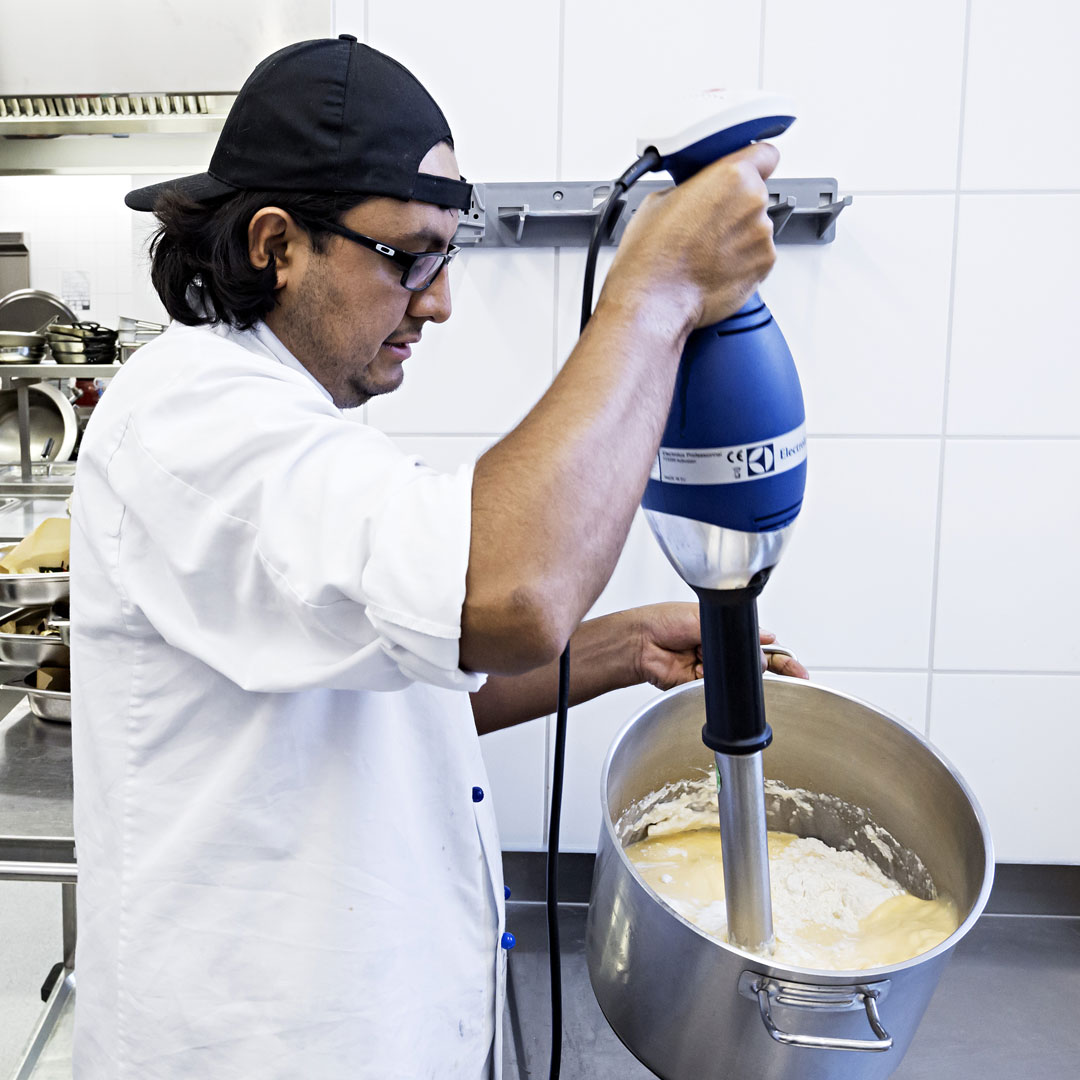
BermixerPro provides a useful example. Electrolux Professional offers models across different power levels and tube lengths, with capacities ranging from smaller batches through to models designed for very large quantities. The 450W model with a 453mm tube, for example, is specified for capacities up to 100 litres, while the 650W 553mm model is specified for up to 220 litres.
The important point is not simply choosing the largest available model. Capacity should correspond with the actual batch sizes being produced. Overspecifying equipment can take up unnecessary space and add cost, while underspecifying it can create additional production cycles and labour.
Consider Where Preparation Happens
Equipment selection also needs to consider the physical workflow of the kitchen.
A preparation task may happen at a dedicated bench, beside refrigeration, close to the cooking line or directly in a stock pot or container. Equipment that fits naturally into that workflow can eliminate unnecessary transfers of ingredients and reduce handling.
This is one of the practical advantages of equipment such as BermixerPro. Selected models are designed to be used directly in stock pots, allowing ingredients to be processed where they are being prepared rather than transferred to a separate vessel. The range also uses removable food-contact components and dishwasher-safe tubes, knives and whisks on supported models, helping simplify cleaning between tasks.
The same principle applies across food preparation equipment. The best solution is not necessarily the machine with the greatest output. It is the one that fits the production process without creating another step for the kitchen team.
Think About Cleaning and Daily Use
Preparation equipment is used repeatedly, so cleaning and handling should be considered alongside production capacity.
Components that come into contact with food need to be accessible for cleaning, while equipment should be practical for the staff who use it throughout the day. If a preparation machine is difficult to clean, difficult to move or awkward to store, those issues become part of the daily labour requirement.
The right preparation equipment is not simply the machine that does the job. It is the machine that does the job efficiently, repeatedly and in the place where the kitchen needs it done.
The range also incorporates ergonomic handling and adjustable speed control to suit different preparation tasks. These details may appear small when selecting equipment, but they become much more significant when a machine is used repeatedly throughout every service.
Build Preparation Around the Way the Kitchen Works
Food preparation equipment should ultimately be considered as part of the wider kitchen workflow rather than as a collection of individual appliances.
The right combination will depend on the menu, production volumes, staffing, available space and the way food moves through the kitchen. A restaurant may prioritise flexibility and compact equipment, while a healthcare or institutional kitchen may place greater emphasis on batch production, consistency and repeatability.
Eurotec Australia's food preparation equipment range brings together different Electrolux Professional solutions for these preparation requirements, from vegetable processing and mixing through to vacuum packing and other specialised applications.
Electrolux Professional equipment is designed around the demands of professional food production, while Eurotec Australia supports the Australian market as the official distributor through its dealer network. The result is a preparation equipment range that can be specified around the way a commercial kitchen actually operates, rather than forcing the workflow to fit the equipment.